— DELRAY BEACH TREATMENT ANSWER
Can water filtration remove Delray Beach’s yellow tint?
Possibly—but “yellow water” is a symptom, not a treatment specification. Filtration can improve certain dissolved or particulate causes of color, taste and odor. It cannot fix every plumbing problem or an active utility disturbance.
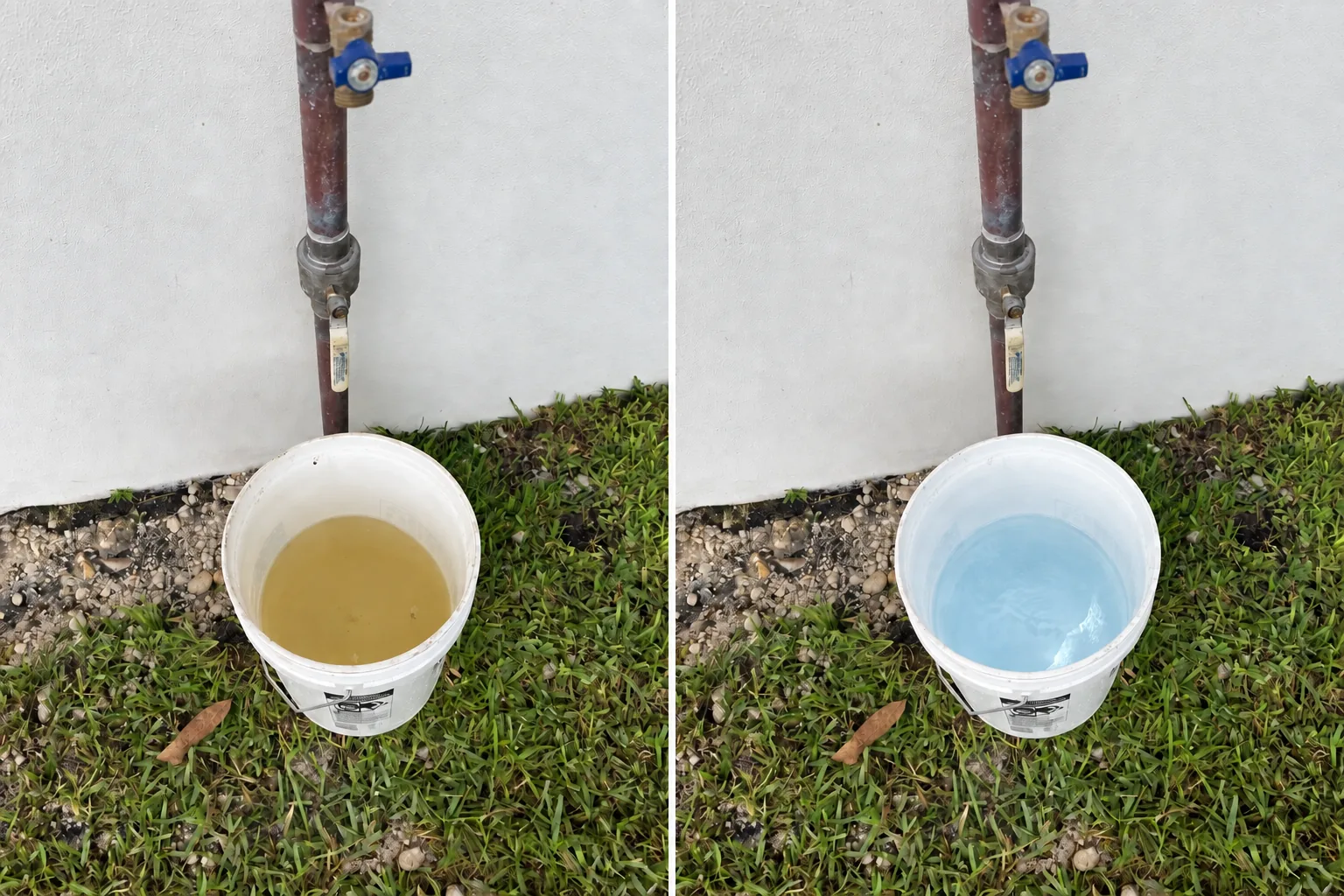
These field photos show visible appearance at one property. They are not laboratory results and do not establish water conditions or treatment performance throughout Delray Beach.
- Confirm that the tint is present on the cold-water supply.
- Determine whether nearby homes see the same condition.
- Check for active utility work or advisories.
- Test the actual water before selecting media or equipment.
- Require performance claims that match the contaminant or condition being addressed.
Why the cause matters
A properly designed whole-home process may improve color, but testing and treatment capacity matter.
Particulate and dissolved iron behave differently and may require different treatment approaches.
Whole-home filtration does not repair corrosion or sediment inside an existing heater.
Permanent equipment should not be prescribed to solve a short-lived utility event.
Where tannin-removal resin fits
When testing indicates that yellow color is being caused by tannins or other naturally occurring organic matter, a potable-water-rated anion exchange resin designed for tannin and organic removal can reduce the color. Manufacturers describe these resins as organic scavengers used for tannin, natural-organic-matter or total-organic-carbon removal.
This is treatment, not a permanent elimination of the source. The resin has finite working capacity. Depending on the specific resin and system design, it must be regenerated as prescribed or eventually replaced or rebedded. If its capacity becomes exhausted or the maintenance cycle is missed, color can return.
The City describes naturally occurring minerals and color in its source water, but its public explanation does not establish that tannins are the cause at every address. Tannin resin should be presented as a treatment option only when the water profile supports it—not as a universal Delray solution.
What should be tested?
The useful test depends on the concern. Color, iron, manganese, pH, hardness, TDS and disinfectant residual can each inform a different part of the treatment decision. A basic field test does not measure every regulated contaminant, and TDS cannot identify which dissolved substances are present.
A TDS meter estimates the total concentration of dissolved ions through conductivity. It cannot tell whether visible tint comes from natural organic color, iron, manganese, plumbing or a temporary distribution event.
How to judge a treatment recommendation
Ask what measured condition the system is intended to reduce, where it is installed, what flow rate and capacity apply, what maintenance is required and whether the relevant performance claim is independently certified. A vague promise that a system “removes chemicals” is not enough.
Why whole-home and drinking-water treatment are different
Whole-home treatment addresses water throughout the property and is often evaluated for aesthetic conditions such as color, taste, odor or hardness. Point-of-use treatment addresses water at a specific drinking tap and may be selected for particular dissolved substances. Neither category should be treated as universally superior; the correct scope follows the goal and the evidence.
— INFORMATION BEFORE EQUIPMENT
Start with Delray’s public report.
Then, if you want exact hardness and TDS measurements from your address, request a separate home test. The report remains available without a form.
Sources and standards
- City of Delray Beach: Water Color FAQ
- EPA: Secondary Drinking Water Standards
- ResinTech: Potable-water tannin and natural-organic-matter resin
- Purolite: Organic scavenger and tannin-removal resin
- NSF: Standards for water treatment systems
Updated August 23, 2026. Treatment claims must be evaluated against the actual water and the specific product certification.